Blackberries Taking Over? How to Get an Overgrown Patch Back Under Control
Valley Outdoors
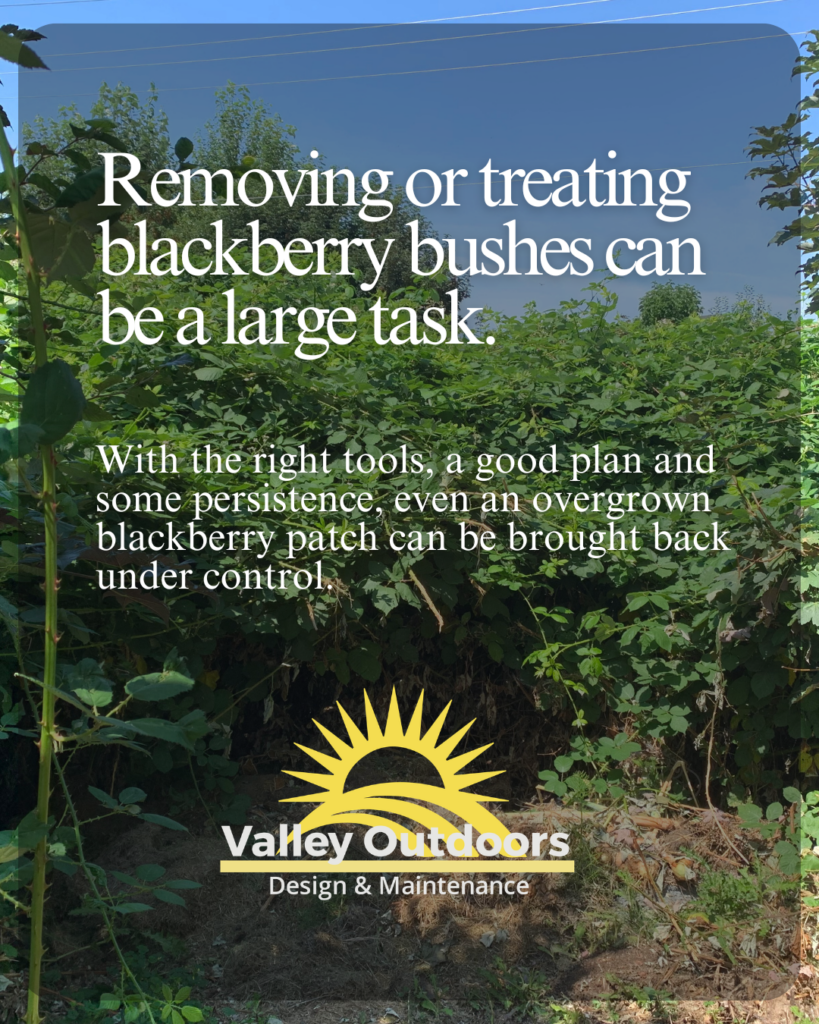
If you live in the Fraser Valley, chances are you've seen blackberry bushes take over a fence line, ditch, slope or forgotten corner of a yard.
They often start small and don't seem like much of a problem. But Himalayan blackberry is an aggressive invasive plant in British Columbia, and once established, it can form dense thickets and quickly take over unused areas.
So, what can you do when blackberries start taking over your property?
Where Do Blackberry Bushes Typically Grow?
Blackberries are particularly good at establishing themselves in areas that aren't regularly maintained. Around Fraser Valley properties, we commonly see them growing along:
- Fence lines and property edges
- Slopes and ditches
- Behind sheds and outbuildings
- Neglected garden areas
- Open or disturbed ground
Once established, their long canes can spread into surrounding areas and create large, dense patches.
There is another reason blackberry plants sometimes seem to appear out of nowhere: birds and other wildlife eat the fruit and spread the seeds. This means entirely new plants can pop up elsewhere in your yard, even if you've dealt with an existing patch.
Option 1: Cut and Dig
If you prefer not to use herbicide, blackberry bushes can be tackled manually.
Start by cutting the canes down hard. Depending on the size and age of the patch, this may require loppers, pruning saws or powered cutting equipment. Heavy gloves, long sleeves and eye protection are also important when working around thorny blackberry canes.
Once the canes have been cleared away, the next step is to dig out as much of the root crown and root system as possible.
Simply removing the visible growth usually isn't enough. Blackberry plants can regrow from what's left behind underground, so it may take more than one season to get an established patch completely under control.
Option 2: Cut and Treat the Regrowth
Another approach is to cut back the mature blackberry canes and then allow some fresh, leafy growth to emerge.
That actively growing regrowth can then be treated with an appropriate registered herbicide, following the product label and applicable local regulations.
The goal isn't simply to remove what you can see above ground. Effective blackberry control also means dealing with the established plant so that it is less likely to continue returning.
The Most Important Step: Don't Assume They're Gone
Whichever method you choose, follow-up is one of the most important parts of controlling blackberries.
Watch the area closely throughout the following year. If new blackberry shoots appear, deal with them while they're small rather than allowing them to become established again.
Even after you've successfully removed an existing patch, new plants can still appear from seeds carried by birds and other wildlife.
A quick check of previously affected areas every so often can save a much bigger job later.
Blackberries in the Fraser Valley
Blackberries are a familiar sight throughout Chilliwack and the Fraser Valley. While a few blackberry canes may not look like much at first, giving them a few seasons to grow can result in a surprisingly large patch.
The good news is that even an overgrown blackberry area can be brought back under control.